
The Most Deadly Disease

In this episode: The Most Deadly Disease . . .


Criticisms, constant complaining, and derogatory comments about fellow co-workers. While working retail, I repeatedly heard remarks like this: “You can’t imagine how miserable it is working with these clowns.”

Admit it, you’ve caught yourself sharing the misery of your “difficult co-workers” with other people on break, at lunch, before or after work. It’s been said, “Misery loves company.” Don’t join the crowd.

Zig Ziglar called it stinkin’ thinkin’ - boy, was he right on!

Did you know the most deadly disease on Earth is not COVID-19, although, right now, it may seem that way?

It’s Hardening of the Attitudes.
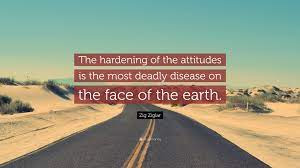
Thankfully there is a way to reverse this destructive tendency. It’s a simple daily process. Author Ken Blanchard shares the secret in many of his parables, “Catch people doing something right.”

Did you pick out the keyword in the previous statement? Simple. However, I must warn you it’s not easy. This takes a concerted effort on your part.

What’s the process, you ask? Three manageable steps:

Step one: Send a thank you note, a smile, or an emoji in a text. It’s those little things that make a big difference. Take action now. When you act,  you will reshape your habits and your attitude.

Step two: Find something constructive and positive to say the next time you talk about anyone with a friend or fellow worker.

Step three: Right now, catch yourself doing something right. My guitar instructor calls it - Today’s Small Win. 

Robert Schuller put it this way, “Inch-by-inch, its a cinch.”

Then as you walk away from any conversation, stop - take a minute - pat yourself on the back, and consider how good it feels to build up others and, most importantly yourself.

I’m convinced, as Zig Ziglar always said, “When you treat people exactly like you see them, you get the results you expect.”

So why not expect the best!

I’m Patrick Ball; thanks for listening. See you in the next episode . . .

Comments

Most Popular of All Time

Truth for Sale

This episode is inspired  by Elton John & Bernie Taupin On Memorial Day, I took my first bike ride  since the accident , seeking proof that my legs, lungs, and nerves still remembered the road. The morning air carried that familiar Southern California mix of ocean haze, exhaust, eucalyptus, and sun-baked asphalt. My tires hummed across pavement I’ve ridden for years. Somewhere between the steady click of the chain and the rhythm of my breathing, Elton John and Bernie Taupin’s The Captain and the Kid found its way into my ears. There’s a strange kind of magic when the cadence of a ride syncs perfectly with a song you know by heart. Suddenly, the music and lyrics stop being background noise and become a lens. And through that lens, the road started talking. I've been cycling on this road some, Can't help feeling I've been showing my friends around. I've seen it grow from next to nothing, To a giant eatin’ up our town. Called up the tealeaves and the tarots, Asked the...

Epictetus, Ego, and Acronyms

In this episode, Destroy Communication, One Three-Letter Acronym at a Time This week, I want to explore a deeply relatable, universally feared workplace character: the "know-it-all." Now, I’m not pointing fingers here. If we are being completely honest, we have all played this role. We've all uttered some version of, "Yes, absolutely, that aligns with our strategic objectives," while our internal monologue is screaming, "I don't even know what the objective is, let alone the strategy." What got me thinking about this was a chapter in Ryan Holiday's book, Wisdom Takes Work . Holiday leans on a powerful piece of Stoic truth from the ancient philosopher Epictetus: "It is impossible for a man to learn what he thinks he already knows." It's a brilliant quote that strikes right at the heart of the human ego. You can't learn what you already know, and you certainly can't learn what you pretend to know to save face. Though to be ...

Breaking the Script

In this episode, The Art of the Short-Circuit. We spend a surprising amount of our lives on conversational autopilot. You see it everywhere. At the hardware store. At the post office. In office hallways, where two people can exchange greetings, discuss the weather, and continue on their way without either one actually hearing what the other said. "How are you?” "Good. You?” “Busy." “Yep." It's less of a conversation and more of a system check. Most of us aren't being rude. We're just moving fast. We have emails to answer, meetings to attend, errands to run, and a hundred other things competing for our attention. Before long, our interactions become little more than verbal lane markers helping us navigate the day. I like to break the script. When I run into someone, instead of the usual greetings, I'll ask: "What's the good word?” The reaction is almost always worth it. You can practically see the gears stop turning. People pause. They blink....

That Fateful Four-Letter Word

In this episode, A Masterclass in Efficiency. For nearly four months, the western border of our property has stood as a living monument to determination, dubious planning, and forensic-level lumber acquisition. Since February, our neighbor Steve has been conducting what can only be described as a masterclass in deliberate calculation. This was never going to be one of those slick home-improvement shows where a cheerful pair of men installs a fence between commercial breaks, sipping lemonade. No. This was real life in retirement. We scaled the vertical wilderness of our hillside. We mixed concrete with the precision of medieval alchemists. We bled, we sweated, and we fought hand-to-hand with a buried tree stump that had the structural integrity of a Cold War bunker. By this week—May 16th, for those keeping score—the glorious end was finally within reach. The fence stood proudly, the line was straight, and victory practically hummed in the air. Only one major task remained: installing t...